

Bruno de Oliveira Magalhães Jan 29, 2026 4 minutes
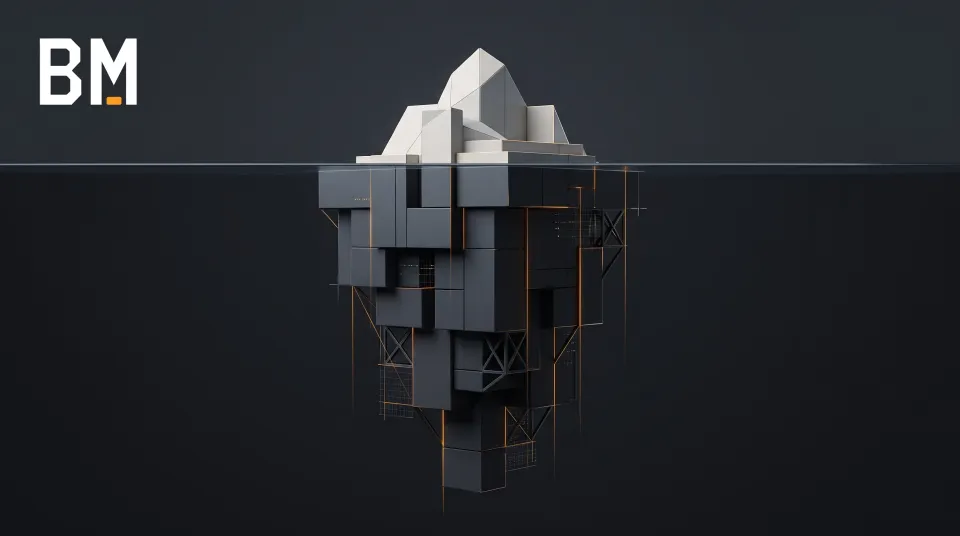
Table of contents
A reflection on the true origins of the chaos haunting our projects
Twenty-five years of programming. How many icebergs have we navigated? How many times have we heard the desperate cry: "The code is a mess!" followed by the inevitable: "We need to refactor everything!"?
The image I am analyzing today captures, with surgical precision, a truth few dare to put into words: most technical debt does not stem from bad technical decisions. It originates on the floor above.
The Theater of the Absurd: When Business Throws Stones
Look at the upper scene in the illustration. Executives in suits dump heavy blocks onto the development team. Each block carries a familiar label:
"Urgent Scope Change" — The classic. Three sprints of architecture thrown away because "the market changed." The database modeled for e-commerce now has to become a marketplace. Overnight.
"Unrealistic Deadline" — "You have two weeks for what you planned in two months. Oh, and no bugs, please." The result? Code that works like a house of cards: impressive at first glance, catastrophic at the slightest breeze.
"Lack of Planning" — Starting to build without a blueprint. Discovering requirements during implementation. Changing the architecture mid-way because "we forgot" to mention the system needs to support 10 million users.
"Insufficient Resources" — A team of three developers to build the "company's Netflix" in six months. On a startup budget with FAANG expectations.
The Underworld of Code: Where Developers Drown
At the bottom, we see the raw reality: developers submerged up to their necks in murky water, surrounded by tangled cables, jammed gears, and lost documentation. Their laptops, tools of creation, have become anchors.
But the most powerful detail? The sign emerging from the waters: "WE WARNED YOU".
Words that echo decades of frustration. How many meetings have started with: "Folks, you're being too pessimistic"? How many technical warnings were labeled as "resistance to change"?
The Iceberg Metaphor: Cause and Consequence
Ward Cunningham coined the term "technical debt" as a financial metaphor: a loan that accelerates development, but charges interest. The image goes further. It shows that we often do not choose to take on this debt; it is imposed on us.
The iceberg reveals its anatomy:
- Visible surface: Bugs, slowness, difficulty implementing features
- Submerged mass: Management decisions that ignored technical reality
The Real Cost of "Faster"
Every block thrown from above generates waves that ripple outward:
- Defensive code: Developers build layers of protection against future changes
- Over-engineering: Attempts to anticipate every possible scenario
- Nonexistent documentation: There is no time to explain what was built
- Fragile tests: Low coverage because "there's no time"
- Reactive architecture: Every new demand turns into a patch
Shared Responsibility
As seniors, our mission transcends code. We are translators between worlds:
For business: Converting technical risks into financial impact. "This scope change will cost three weeks of development and increase the risk of bugs by 40%."
For the team: Teaching how to communicate consequences objectively, not emotionally. Data, not opinions.
For ourselves: Accepting that part of our responsibility is political. Influencing decisions before the blocks are dumped.
The Speed Paradox
The irony is cruel: pressure for speed generates slowness. Unrealistic deadlines produce code that takes longer to evolve. Constant scope changes create more complex and fragile systems.
True agility is born from balance: sustainable speed, flexible architecture, transparent communication.
Conclusion: Emerging from the Waters
The "WE WARNED YOU" sign shouldn't be an epitaph, but a manifesto. Our experience teaches us that:
- Technical debt is a symptom, not the disease
- The cure requires cultural change, not just refactoring
- Our technical voice needs to echo in the halls of decision-making
Twenty-five years have taught us that clean code is not enough. We need clean organizations, clean processes, clean communication.
The iceberg will continue to exist. But perhaps, with our experience and persistence, we can navigate around it, instead of colliding head-on, once again.